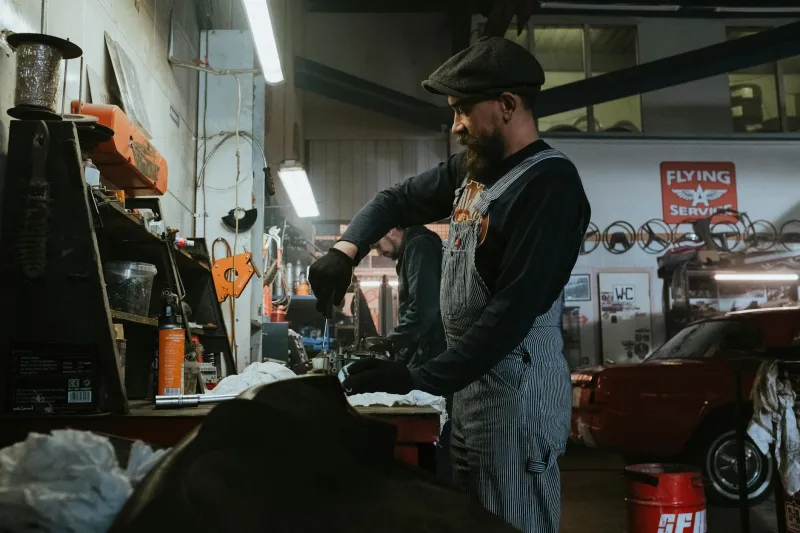
Every neighborhood had one: that slightly grease-stained guy in coveralls who could diagnose your car's problem just by listening to the engine idle. His shop sat on the corner, usually in a converted gas station, with a hand-painted sign that had weathered a few decades of seasons. When your car started making that weird noise, you didn't call ahead—you just drove over and asked, "Hey Frank, got a minute?"
That world is gone, and most of us didn't even notice it disappearing.
The Corner Garage Was More Than a Business
In the 1970s and 80s, independent auto repair shops dotted American communities like coffee shops do today. These weren't fancy operations—most featured a couple of hydraulic lifts, walls lined with tools that had seen decades of use, and a coffee pot that had been brewing the same bitter blend since the Carter administration.
But what made these places special wasn't the equipment—it was the relationship. Your mechanic knew your car's history because he'd been working on it for years. He remembered that your transmission had been acting up last spring, or that your alternator was on borrowed time. When you brought your car in, he didn't need to run a computer diagnostic to figure out what was wrong. He could often identify the problem before you even turned off the engine.
More importantly, he knew you. He understood that you were a single mom trying to make your car last another year, or a college student who needed the cheapest possible fix. The repair estimate wasn't generated by corporate software—it was a conversation between two people who had to look each other in the eye.
When Car Repair Made Sense to Regular People
The cars of that era were mechanical marvels in their simplicity. Pop the hood of a 1978 Chevrolet, and you could actually see the engine. The carburetor, distributor, and alternator were right there, accessible with basic tools. A reasonably handy person could replace spark plugs, change belts, and even swap out a starter without special equipment.
This mechanical transparency extended to the repair process. When your neighborhood mechanic explained what was wrong, you could follow along. He'd show you the worn brake pads, the cracked radiator hose, or the corroded battery terminals. The problems were visible, the solutions were straightforward, and the costs were predictable.
Parts were interchangeable across different manufacturers, and aftermarket alternatives were widely available. Your mechanic could often fix your car with parts from the local auto parts store, and many repairs could be completed the same day. A typical brake job might cost $60 and take two hours. An oil change was a $15, 20-minute operation.
The Dealership Takeover
Somewhere along the way, cars became computers on wheels, and the neighborhood garage became an endangered species. Modern vehicles arrive from the factory with dozens of electronic control modules, proprietary diagnostic systems, and software that requires special tools to access.
Today's dealership service centers look more like hospitals than garages. Technicians—they're not called mechanics anymore—wear clean uniforms and work with tablet computers instead of wrenches. The diagnostic process alone can cost $150, and that's before anyone even touches your car.
The transparency that once defined car repair has been replaced by technological opacity. When your check engine light comes on, the problem could be anything from a loose gas cap to a failed catalytic converter. The diagnostic computer spits out error codes that mean nothing to most car owners, and the recommended repairs often sound like they require a degree in electrical engineering.
The Price of Progress
This transformation has come with a staggering financial cost. What used to be a $200 repair bill has become a $800 service appointment. Routine maintenance that once cost pocket change now requires monthly budgeting. The average car repair bill in 2023 exceeds $500, and major repairs can easily run into thousands of dollars.
But the financial impact tells only part of the story. The relationship between Americans and their cars has fundamentally changed. We've gone from understanding our vehicles as mechanical devices we could maintain and repair to viewing them as mysterious electronic appliances that only certified technicians can service.
This shift has created a new form of learned helplessness. Previous generations of car owners could at least attempt basic repairs or seek multiple opinions from different mechanics. Today's drivers are largely at the mercy of whoever has the right diagnostic equipment and software access.
What We Lost in Translation
The death of the neighborhood garage represents more than just economic change—it's a story about the loss of human-scale business relationships in American communities. These shops were gathering places where local knowledge was shared and neighborhood connections were maintained.
Your mechanic was invested in your community because he lived there too. His reputation depended on treating customers fairly, and word of mouth could make or break his business. The incentive structure encouraged honest diagnoses and reasonable prices because customer relationships were built over years, not individual transactions.
Contrast that with today's dealership service model, where you're unlikely to see the same service advisor twice, let alone develop a relationship with the person actually working on your car. The technician is following diagnostic protocols developed by corporate engineers, and the pricing is determined by software that factors in everything from local market conditions to your car's warranty status.
The Ripple Effects
The transformation of auto repair has had consequences that extend far beyond the garage bay. Small business ownership opportunities disappeared as independent shops were squeezed out by technological barriers and manufacturer restrictions. The skilled trades that once offered middle-class livelihoods without college degrees became increasingly specialized and corporate-controlled.
Perhaps most significantly, we lost a form of practical knowledge that once connected ordinary Americans to the machines they depended on daily. The ability to understand, maintain, and repair our cars was part of basic adult competency. That knowledge has been replaced by warranty plans and roadside assistance programs—services that treat car ownership as a form of managed dependency rather than mechanical mastery.
The guy in coveralls who knew your engine by heart wasn't just fixing cars—he was maintaining a connection between people and the technology that shaped their daily lives. When that relationship disappeared, we didn't just lose a service provider. We lost a piece of American self-reliance that we're only now beginning to understand we can't afford to live without.