The Tuesday Morning Symphony
Every Tuesday at 7:30 AM, Mrs. Dorothy Kellerman would hear the familiar rumble of Charlie's ice truck turning onto Maple Street in Cedar Rapids, Iowa. She'd already placed her ice card in the front window—"25 lbs" facing out—and by the time Charlie's heavy boots hit her front porch, she had coffee brewing and yesterday's newspaper folded neatly for him to take.
 Photo: Maple Street, via maplestreetschool.com
This wasn't just commerce. This was choreography.
Charlie knew that Mrs. Kellerman's husband worked the early shift at the plant, that her daughter was getting married in September, and that she worried about her son stationed in Korea. Mrs. Kellerman knew that Charlie's truck needed new brakes, that his wife was expecting their third child, and that he'd been saving up to buy his own route.
Multiply this scene by millions of American homes in the 1940s and 1950s, and you begin to understand something we've completely forgotten: entire neighborhoods once moved to the rhythm of home delivery.
The Weekly Dance
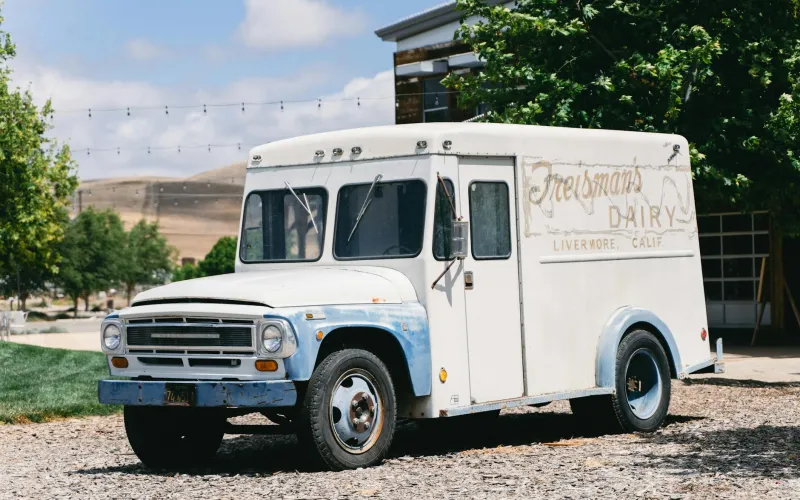
Before supermarkets dominated American shopping, home delivery wasn't a luxury—it was the backbone of domestic life. The milkman came Monday, Wednesday, and Friday. The iceman arrived Tuesday and Saturday. The bread truck rolled through Thursday afternoons. The laundry service picked up on Monday and delivered on Wednesday.
Families planned their weeks around these visits. Children learned the days of the week by memorizing delivery schedules. Housewives timed their morning routines to coincide with their favorite delivery drivers, turning brief commercial transactions into the social highlights of their day.
The system worked because it was predictable, personal, and deeply integrated into community life. Your milkman didn't just deliver dairy products—he was your early warning system for neighborhood news, a trusted figure who noticed if your newspapers were piling up, and someone who'd leave an extra bottle of cream when he knew you were hosting your bridge club.
More Than Convenience
What made the old delivery system different from today's wasn't just the personal relationships—it was the way those relationships created informal safety nets throughout American neighborhoods.
Delivery drivers became the unofficial guardians of their routes. They knew which elderly customers lived alone and made sure to check on them. They'd notice if a house looked empty too long or if something seemed off. During emergencies, they often served as communication networks, carrying messages between families when phone service was unreliable.
The economic relationship was also fundamentally different. Most delivery drivers were either independent contractors or small business owners who built long-term relationships with customers. Your milkman might serve the same route for twenty years, watching children grow up and families change. Customer loyalty meant something because it directly affected someone's livelihood.
The Great Disappearance
By the 1960s, this elaborate system of home delivery was already crumbling. Suburban sprawl made routes longer and less profitable. The rise of supermarkets offered greater variety and lower prices. Most importantly, the refrigerator revolution meant families could store more food for longer periods, reducing the need for frequent deliveries.
The social changes were just as significant. As more women entered the workforce, fewer people were home during traditional delivery hours. The predictable rhythms that had organized domestic life became obstacles to families juggling multiple schedules.
By 1970, the milkman had largely vanished from American life. The iceman was already a memory, replaced by electric refrigerators. Home delivery became something only the wealthy could afford, and even then, it was limited to special occasions.
The Return of Everything
Fast-forward fifty years, and home delivery has exploded beyond anything those 1950s families could have imagined. Americans now have groceries, restaurant meals, prescriptions, and virtually any consumer good delivered to their doors within hours.
The numbers are staggering. Amazon alone delivers over 3.5 billion packages annually. Food delivery services like DoorDash and Uber Eats have created an entire gig economy. During the pandemic, home delivery became so essential that "essential worker" often meant "delivery driver."
But this new delivery culture operates on completely different principles than the old system. Modern delivery prioritizes speed over relationships, convenience over community, and efficiency over personal connection.
Strangers at the Door
Today's delivery drivers are invisible by design. They're instructed to leave packages without interaction, communicate through apps rather than conversation, and optimize routes for speed rather than relationship building. Most customers never see the same driver twice.
The economic structure reinforces this anonymity. Gig economy drivers work for platforms rather than customers, earning money per delivery rather than building long-term relationships. There's no incentive to learn customers' names, remember their preferences, or check on their well-being.
The technology that makes modern delivery possible—GPS tracking, automated routing, contactless payment—also ensures that human interaction remains minimal. You can have groceries delivered to your door without ever speaking to another person.
What We Gained and Lost
Modern delivery offers unprecedented convenience and choice. You can order Thai food at 2 AM, have groceries delivered in two hours, and receive packages seven days a week. The selection is infinite, the pricing is competitive, and the service is remarkably reliable.
But we've lost something harder to quantify: the social infrastructure that came with the old delivery system. When the milkman knew your schedule better than your calendar did, it meant you were embedded in a web of relationships that provided both practical support and social connection.
The old system created what sociologists call "weak ties"—casual relationships that nonetheless provided social cohesion and community resilience. Your delivery drivers weren't close friends, but they were familiar faces who cared about your well-being and connected you to the larger neighborhood.
The Paradox of Modern Convenience
We've created a delivery system that's more efficient and convenient than anything previous generations could have imagined, but it's also more isolating. Packages appear on doorsteps like magic, but the magic comes at the cost of human connection.
The irony is that in our rush to eliminate the inefficiencies of the old system—the small talk, the regular schedules, the personal relationships—we may have eliminated the very things that made home delivery valuable beyond mere convenience.
Today's delivery culture reflects broader changes in American life: we're more connected but less rooted, more efficient but less personal, more convenient but less communal. We've gone full circle on home delivery, but we haven't returned to the same place—we've landed somewhere entirely different, where packages arrive faster than ever but the people who bring them remain strangers.