The Corner Lot Where Everyone Knew Your Name
Picture this: It's 1975, and you need a new car. You drive down to Miller's Ford on Main Street, where Bob Miller — the same guy who sold your dad his first pickup — waves from behind the glass office. You've seen Bob at church, at your kid's Little League games, and at the annual Fourth of July barbecue. When you walk onto his lot, he doesn't ask for your credit score. He asks about your family.
This wasn't just small-town charm. This was how America bought cars for decades. The local dealership was woven into the fabric of the community, and buying a vehicle was as much about relationships as it was about transportation.
Today, that world has vanished so completely that describing it sounds almost fictional.
When a Handshake Was Worth More Than a Credit Report
In the 1960s and 70s, car buying followed a predictable rhythm. You'd spend a Saturday morning walking the lot, kicking tires (literally), and chatting with a salesman who probably lived three streets over. The negotiation happened face-to-face, often over coffee in a cramped office decorated with family photos and community awards.
Most remarkably, financing was often arranged with nothing more than a conversation. The dealer knew your employment history not from a database, but because he'd watched you work at the same job for years. Credit checks existed, but they were secondary to personal knowledge. If Bob knew you were good for it, that was often enough.
Contrast this with today's experience: Before you even step foot in a dealership, algorithms have already analyzed your digital footprint, assigned you a credit tier, and determined your likely monthly payment range. The "pre-approved" offers flooding your mailbox aren't based on personal relationships — they're generated by data models that know more about your spending habits than your neighbors do.
The Rise of the Corporate Showroom
Something fundamental shifted in the 1990s and 2000s. Independent dealerships began consolidating into corporate chains. AutoNation, founded in 1996, now operates over 300 locations across the country. These aren't neighborhood businesses passed down through generations — they're standardized retail experiences designed for efficiency, not relationships.
Walk into a modern dealership, and you'll find it feels more like an Apple Store than Miller's Ford. Everything is sleek, branded, and designed to move inventory quickly. The salespeople are often recent hires working toward monthly quotas rather than community fixtures building lifetime relationships.
The numbers tell the story: In 1990, there were roughly 25,000 new car dealerships in America. Today, despite a larger population and more car sales, there are fewer than 17,000. The survivors are bigger, more corporate, and increasingly disconnected from the communities they serve.
When Shopping Moved Online
The digital revolution didn't just change how we research cars — it fundamentally altered the entire buying process. Websites like Cars.com and AutoTrader shifted power to consumers, who could now compare prices, read reviews, and even arrange financing before ever talking to a human being.
This sounds like progress, and in many ways it is. Today's car buyers are better informed and less likely to fall victim to high-pressure sales tactics. But something was lost in translation: the human element that once made buying a car feel like a community event rather than a financial transaction.
Consider the modern car-buying journey: You research online, get pre-approved through a digital lending platform, configure your vehicle through the manufacturer's website, and might even complete the entire purchase without meaningful human interaction. Some companies, like Carvana, have eliminated the dealership entirely, delivering cars to your driveway like oversized Amazon packages.
The Algorithm Knows You Better Than Your Neighbor
Today's car financing is a marvel of data science and risk assessment. Lenders can analyze hundreds of variables in seconds, from your payment history to your social media activity, to determine not just whether you qualify for a loan, but what color car you're most likely to choose.
This efficiency comes at a cost. The personal touch that once defined car buying has been replaced by algorithmic precision. Your creditworthiness is no longer a matter of community reputation — it's a three-digit number generated by mathematical models.
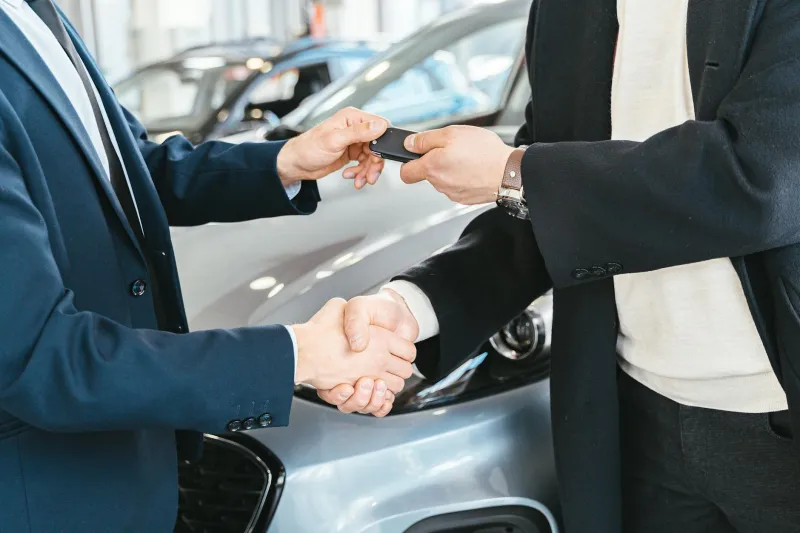
The irony is striking: We have more information about car buyers than ever before, yet the buying process feels more impersonal than it did when decisions were made over handshakes and coffee.
What We Gained and What We Lost
There's no denying that modern car buying offers advantages our grandparents couldn't imagine. Transparent pricing, comprehensive vehicle histories, and competitive financing options have made the process fairer and more efficient. No longer can a dealer take advantage of uninformed buyers or discriminate based on personal biases.
But efficiency isn't everything. The transformation of car buying from a relationship-driven experience to a data-driven transaction reflects a broader shift in American commerce. We've gained convenience and fairness, but we've lost something harder to quantify: the sense that major life purchases are community events rather than solitary financial decisions.
The neighborhood car dealer who knew your family, understood your needs, and stood behind every sale has been replaced by corporate efficiency and digital convenience. Whether that's progress or loss depends on what you value more — the warmth of human connection or the cold precision of data-driven commerce.
Either way, the handshake deal is dead, and we're still figuring out what we've traded it for.