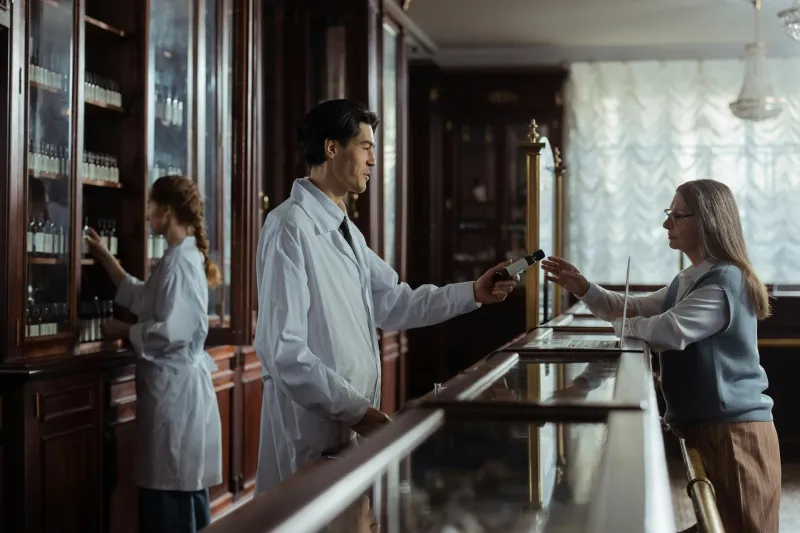
Walk into any CVS or Walgreens today, and you'll find yourself in a maze of greeting cards, snack foods, and beauty products before you even glimpse the pharmacy counter tucked away in the back corner. When you finally reach that counter, you'll hand over your prescription to someone who might ask for your birthdate twice before finding your profile in the computer system.
This sterile, impersonal experience would have seemed like science fiction to Americans in the 1970s and 1980s, when neighborhood pharmacies operated more like family practices than retail outlets.
The Pharmacist Who Knew Your Story
In 1980, most Americans filled their prescriptions at independent pharmacies owned by pharmacists who had been serving the same neighborhoods for decades. These weren't just pill-dispensing operations—they were community institutions where the pharmacist knew not just your name, but your medical history, your family's health patterns, and often your personal circumstances.
Take Harold Brennan, who ran Brennan's Pharmacy in Queens for thirty-seven years until he sold to a chain in 1995. Brennan kept handwritten index cards for each customer, noting not just their prescriptions but their concerns, their questions, and even their financial struggles. When Mrs. Rodriguez couldn't afford her blood pressure medication, Brennan would quietly arrange a payment plan. When teenage Tommy Sullivan came in looking embarrassed about acne medication, Brennan would slip it into a plain bag without comment.
"I knew three generations of some families," Brennan recalls. "I watched kids grow up, get married, have kids of their own. You can't provide that kind of care when you're processing 500 prescriptions a day for strangers."
The Five-Minute Fill and the Personal Touch
Back then, getting a prescription filled was refreshingly simple. You walked into your neighborhood pharmacy—often located in the same strip of shops where you bought groceries and got your hair cut—handed over the prescription, and waited about five minutes while the pharmacist counted out pills from large bottles behind the counter.
But those five minutes weren't wasted time. The pharmacist would often use them to check in about how you were feeling, whether the medication was working, or if you had any concerns. They'd catch potential problems before they became serious—not through computer algorithms, but through the kind of intuitive knowledge that comes from treating the same people for years.
When your doctor prescribed something new, your pharmacist might call to discuss it. Not because a computer flagged an interaction, but because they remembered that you'd had stomach problems with similar medications before, or because they knew you were caring for an aging parent and might be too stressed to remember proper dosing instructions.
The Algorithm Revolution
Today's pharmacy experience is built around efficiency and scale rather than relationships. The average chain pharmacy fills about 250 prescriptions per day—nearly five times what a typical independent handled in 1980. Automated dispensing machines count pills with mechanical precision. Computer systems instantly cross-reference every medication in your profile, checking for interactions that would have required years of training to spot manually.
When you pick up your prescription, you'll likely interact with a pharmacy technician rather than the pharmacist, who might be managing three locations simultaneously through computer systems. The person handing you your medication has probably never seen you before and won't remember you next time.
Your prescription history is stored in vast databases that can be accessed instantly from any location in the chain. Insurance verification happens automatically. Refill reminders arrive via text message or app notification. You can even have medications delivered to your door without speaking to a human being at all.
What We Gained—And What We Lost
There's no question that modern pharmacy systems offer advantages that independent drugstores couldn't match. Today's safety protocols prevent thousands of dangerous interactions and dosing errors. Automated systems ensure consistency and reduce human error. Chain pharmacies stay open longer hours and offer services like flu shots and basic health screenings.
The scale of modern operations has also driven down costs. Generic medications that cost $30 at an independent pharmacy in 1985 might cost $4 at a chain store today, even before adjusting for inflation.
But the human element that defined neighborhood pharmacies has largely vanished. Today's pharmacists are highly trained professionals, but they're managing systems rather than relationships. They're solving technical problems rather than providing personal guidance.
The Ripple Effects
The transformation of American pharmacies reflects a broader shift in how we approach healthcare—from personal relationships to institutional systems, from local knowledge to algorithmic efficiency. When your pharmacist knew your family's medical history by heart, they served as an informal bridge between you and your doctor, catching problems and providing reassurance in ways that no computer system can replicate.
Today, that role has been distributed across multiple touchpoints: online patient portals, nurse hotlines, urgent care clinics, and app-based consultations. We've gained access and convenience, but lost the continuity of care that came from having one knowledgeable professional who understood your health journey over time.
The neighborhood pharmacy was never just about filling prescriptions—it was about having someone in your community who understood both medicine and your personal circumstances. In optimizing for efficiency and scale, we've created a system that works better on paper but feels colder in practice.
For better or worse, the days of walking into Brennan's Pharmacy and being greeted by name are over. Whether that trade-off was worth it depends on what you value more: the precision of modern systems or the personal touch of someone who knew your story.