Your Corner Barber Was Better Than LinkedIn: How America Lost Its Real Job Network
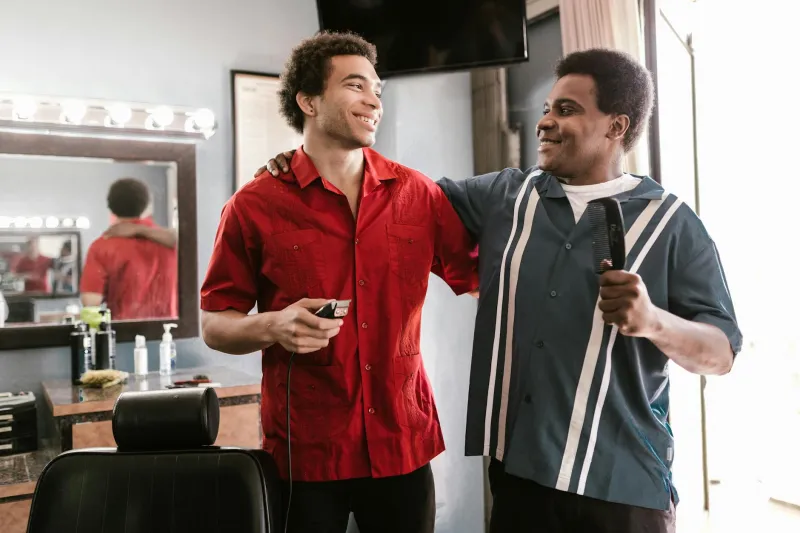
Walk into any barbershop in 1975, and you'd find more than just haircuts happening. Between the buzz of clippers and the snap of hot towels, deals were being struck, recommendations made, and careers launched with nothing more than a handshake and a "I know a guy who knows a guy."
That barbershop wasn't just a business—it was a node in America's most effective job network, one that operated without algorithms, databases, or corporate HR departments. Today, that entire system has vanished, replaced by sterile job boards and AI-powered matching services that somehow make finding work both easier and infinitely more lonely.
When Your Neighborhood Was Your Network
In the pre-internet economy, American neighborhoods functioned like miniature cities, complete with their own internal job markets. The corner diner wasn't just where you grabbed coffee—it was where contractors met potential helpers over breakfast, where the night-shift nurse heard about openings at the hospital, where the mechanic's cousin found out the gas station needed someone reliable.
These weren't formal job placement agencies. They were organic ecosystems where work flowed through relationships, reputation, and proximity. Your barber knew which construction crews were hiring because the foreman got his hair cut every other Tuesday. The dry cleaner heard about office openings because she pressed shirts for half the downtown businesses. The local tavern owner could connect you to everything from trucking jobs to factory work because his customers represented every blue-collar trade in a five-mile radius.
This system was invisible to outsiders but incredibly effective for insiders. A 1980 Department of Labor study found that roughly 70% of jobs were never formally advertised—they were filled through word-of-mouth networks that operated primarily in physical spaces where working people naturally gathered.
 Photo: Department of Labor, via www.vhv.rs
The Architecture of Opportunity
What made this system work wasn't just personal relationships—it was the physical infrastructure of community life. Every neighborhood had what sociologists call "third places": locations that weren't home or work, but served as informal community centers.
The barbershop was perhaps the most important of these. Unlike today's chain salons where you're in and out in 20 minutes, a proper barbershop visit was a social event. Men would wait their turn, reading newspapers, discussing local politics, and inevitably talking about work. The barber himself often knew more about local employment opportunities than the unemployment office.
Similarly, the corner tavern, the local diner, the neighborhood hardware store—these weren't just businesses, they were information exchanges. The hardware store owner knew which contractors were busy (and therefore hiring) because he sold them supplies. The diner waitress knew which factories were doing well because she served their workers lunch. This knowledge flowed naturally through daily interactions.
When Algorithms Replaced Handshakes
The digitization of job searching promised to democratize opportunity. No longer would your career depend on who you knew or where you lived. Online job boards would connect qualified workers with appropriate positions based on skills and experience, not personal connections.
In many ways, this promise was kept. Today's job platforms can match a software engineer in rural Nebraska with a startup in Silicon Valley, something the old neighborhood network never could have accomplished. But something crucial was lost in translation.
 Photo: Silicon Valley, via lwfiles.mycourse.app
Modern job searching is simultaneously more efficient and more isolating. You can apply to hundreds of positions from your laptop, but you'll never know if your resume was actually seen by a human being. Algorithms screen candidates based on keywords and qualifications, but they can't account for work ethic, reliability, or that intangible quality old-timers called "good character."
More importantly, the new system assumes that the best jobs are the ones that get posted online. But many of the most stable, well-paying positions—especially in skilled trades—still flow through personal networks. The difference is that these networks are now largely invisible to outsiders.
The Hidden Cost of Efficiency
The neighborhood job network wasn't perfect. It could be exclusionary, favoring people who looked, talked, and thought like the established community. Women and minorities often found themselves shut out of opportunities that flowed freely among white men at the local bar.
But the old system had one crucial advantage: it was based on relationships, which meant it could account for factors beyond what appeared on paper. A young person with no experience but obvious eagerness might get a chance because the shop owner's brother vouched for their character. Someone going through a rough patch might find work because their barber knew they were fundamentally reliable.
Today's algorithmic systems are fairer in theory but often harsher in practice. A gap in employment history, a lack of formal credentials, or the wrong zip code can eliminate candidates before any human ever sees their application. The efficiency we gained came at the cost of the human judgment that once gave people second chances.
What We Lost When We Gained the World
The death of the neighborhood economy wasn't just about jobs—it was about belonging. When your barber could connect you to work, when the diner owner knew your employment situation, when the hardware store clerk understood your skills, you weren't just a worker in the economy. You were a member of a community that had a stake in your success.
Today, we have LinkedIn connections instead of neighborhood relationships, gig platforms instead of steady employers, and career coaches instead of mentors who actually knew us as people. We've gained access to a global job market but lost the security of a local support network.
The irony is that in our rush to make job searching more efficient, we may have made it less effective for the people who need it most. The neighborhood network was never going to land you a job as a tech executive, but it was remarkably good at helping working-class Americans find steady employment that paid the bills and provided dignity.
That barbershop handshake might seem quaint now, but it represented something our algorithmic age has struggled to replicate: the simple power of one person vouching for another, based on nothing more complicated than knowing them as a neighbor and trusting them as a human being.