The American Dad Who Could Fix Anything Is Extinct — And We're All Poorer for It
The Kingdom in the Basement
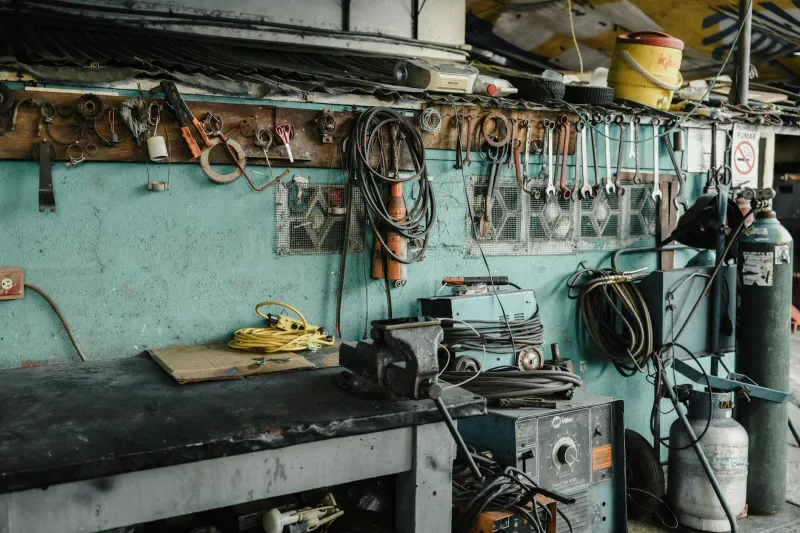
In 1965, nearly every American home contained a sacred space: the workshop. Usually relegated to the basement, garage, or spare room, this was where the family patriarch held court over an impressive array of hand tools, power equipment, and half-finished projects. Pegboard walls displayed carefully organized hammers, screwdrivers, and wrenches. Workbenches bore the scars of countless repairs and creations. Coffee cans filled with screws, nails, and mysterious hardware pieces lined shelves like a hardware store inventory.
This wasn't just storage space – it was a philosophy made manifest. The workshop represented the fundamental belief that things could be fixed, improved, or built from scratch. When the kitchen faucet leaked, Dad didn't call a plumber. When Junior needed a bookshelf, it was crafted from lumber and love rather than purchased from a store. The workshop was where problems were solved, skills were passed down, and the family's relationship with the material world was defined.
When Broken Meant Fixable
The culture surrounding these workshops was built on a simple premise: almost everything could be repaired. Toasters were taken apart and reassembled. Lawn mowers were completely rebuilt each spring. Furniture was reupholstered, refinished, and passed down through generations. The idea of throwing away something because it was broken was not just wasteful – it was a failure of imagination and skill.
Fathers approached problems with a methodical confidence that seems almost quaint today. They diagnosed issues, ordered parts from catalogs, and spent weekends engaged in the meditative work of restoration. Children learned by watching, gradually earning the privilege of holding flashlights, sorting screws, or operating simpler tools under careful supervision.
This hands-on culture extended beyond repairs into creation. Backyard playsets were constructed from scratch. Kitchen cabinets were custom-built to exact specifications. Holiday decorations were crafted rather than purchased. The workshop was where theoretical knowledge became practical skill, where abstract problems became tangible solutions.
The Tools That Built America
Every workshop told a story through its tools. The hand-me-down hammer from a grandfather who built houses during the Depression. The table saw purchased with overtime money and treated like a family heirloom. The collection of specialty tools acquired over decades of tackling increasingly complex projects.
These weren't just implements – they were extensions of their owners' capabilities. A skilled craftsman could accomplish remarkable feats with basic tools, while someone lacking knowledge would struggle even with the most advanced equipment. The relationship between maker and tool was personal, developed through years of shared projects and mutual dependence.
The workshop also served as a library of knowledge. Repair manuals, how-to guides, and manufacturer specifications were carefully filed and referenced. Popular Mechanics magazines dating back years provided inspiration and instruction. This accumulated wisdom represented a practical education that no amount of internet searching could replicate.
The Great Abandonment
The decline began subtly in the 1980s and accelerated rapidly through the following decades. Several forces converged to make the traditional workshop obsolete. Consumer goods became increasingly complex, sealed units that required specialized tools and training to repair. Planned obsolescence made replacement more economical than restoration. The rise of big-box stores brought professional-quality tools within reach, but also made calling a specialist seem more reasonable than learning new skills.
Urban living played a role as well. Apartments and condominiums offered no space for workshops. Even suburban homes began shrinking garage space to accommodate larger cars and more storage needs. The workshop, once a priority in home design, became an afterthought or disappeared entirely.
Perhaps most significantly, the cultural expectation shifted. Fathers who once took pride in their ability to fix anything found themselves working longer hours in knowledge-based careers that left little time for hands-on projects. The skills that previous generations considered essential were no longer valued or necessary for economic success.
Today's Disposable Culture
Modern Americans live in a fundamentally different relationship with material goods. When something breaks, the default response is replacement rather than repair. The cost of professional repair often exceeds the price of buying new. Warranty policies actively discourage tinkering. Products are designed to be sealed, making amateur repair impossible or dangerous.
The few remaining workshops have evolved into specialized hobby spaces rather than general-purpose repair centers. Woodworking has become an expensive pastime rather than a practical skill. Tool collections are carefully curated for specific projects rather than accumulated organically over decades of problem-solving.
Young adults today often lack even basic repair skills that their grandfathers took for granted. Changing a tire, replacing a faucet washer, or fixing a squeaky door hinge requires YouTube tutorials rather than inherited knowledge. The confidence that comes from understanding how things work has been replaced by the anxiety of depending on others for every mechanical problem.
The Hidden Costs of Helplessness
The disappearance of workshop culture represents more than just a shift in how Americans handle repairs. It reflects a broader disconnection from the physical world that has profound implications for how we understand our environment, solve problems, and relate to material possessions.
Children who grew up in workshop cultures developed spatial reasoning, problem-solving skills, and mechanical intuition that served them throughout their lives. They understood that complex systems could be broken down into manageable components, that patience and persistence could overcome seemingly impossible challenges, and that the satisfaction of creating or repairing something with your own hands was unmatched by any consumer purchase.
The economic implications are equally significant. A nation of people who can fix, modify, and create is fundamentally different from one that can only consume. The workshop culture fostered innovation, self-reliance, and resourcefulness that contributed to American industrial dominance throughout the 20th century.
What We Lost When We Stopped Making
The death of the American workshop represents the end of a particular kind of masculine identity built around competence and self-sufficiency. But it also represents the loss of something broader: a culture that valued making over buying, repairing over replacing, and understanding over convenience.
In gaining the ability to solve any problem with a phone call or online purchase, we've lost the deep satisfaction that comes from solving problems with our own hands. We've traded the confidence of self-reliance for the anxiety of dependence. We've exchanged the workshop's quiet pride for the consumer marketplace's endless dissatisfaction.
The few Americans who maintain traditional workshops today often describe them as refuges from a world that seems increasingly disconnected from physical reality. In these spaces, problems still have solutions, broken things can be made whole, and the ancient human satisfaction of creating something useful with your own hands remains unchanged. They represent not just nostalgia for a simpler time, but a different way of being in the world that we abandoned without fully understanding what we were giving up.