America's Lost Crystal Ball: When Tomorrow's Weather Was Anyone's Guess
America's Lost Crystal Ball: When Tomorrow's Weather Was Anyone's Guess
Your great-grandmother planned her wedding date six months in advance without checking a single weather app. She couldn't. The most sophisticated forecast available was a three-day prediction with about the same accuracy as flipping a coin, and even that required walking to the corner drugstore to buy a newspaper.
When the Sky Kept Its Secrets
In 1950, the average American weather forecast extended just 24 hours ahead — and meteorologists got it wrong nearly half the time. Farmers planted crops based on almanacs that tracked moon phases and historical patterns. Families packed for beach vacations knowing they might spend the weekend huddled in a motel room watching rain streak down windows.
The Weather Bureau, as it was called then, operated with a handful of observation stations scattered across the continent. Meteorologists drew weather maps by hand, plotting temperature and pressure readings telegraphed in from distant cities. A storm forming over the Pacific might not be detected until it was already drenching California.
This uncertainty shaped American culture in ways we've completely forgotten. Baseball games started without rain delays because nobody knew if storms were coming. Outdoor weddings were genuine gambles. Construction workers showed up every morning not knowing if they'd work or go home.
The Folklore Weather Network
Without reliable forecasts, Americans developed an intricate system of weather folklore that sounds almost mystical today. Farmers watched how their cows lay down in fields, noting that cattle often sensed approaching storms hours before humans. Fishermen studied the behavior of seabirds, knowing that certain flight patterns meant rough seas ahead.
The Old Farmer's Almanac, first published in 1792, remained America's most trusted long-range weather guide well into the 1970s. Families planned planting schedules around its seasonal predictions, which were based on astronomical calculations, historical weather patterns, and what modern meteorologists would politely call "educated guesswork."
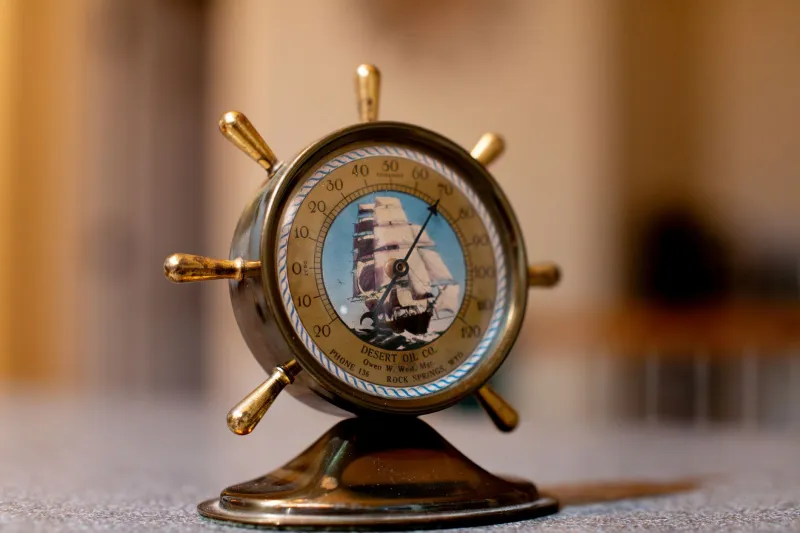
Barometers hung in living rooms like family heirlooms, passed down through generations of Americans who learned to read atmospheric pressure the way we now read text messages. A falling barometer meant trouble was coming, but nobody knew exactly when or how severe.
The Radar Revolution
Everything changed with Doppler radar in the 1980s. Suddenly, meteorologists could see inside storms, tracking wind patterns and precipitation in real-time. The National Weather Service could issue tornado warnings with specific coordinates, telling families in Topeka exactly which neighborhoods needed to take cover.
By the 1990s, local TV meteorologists became minor celebrities, their personalities as important as their predictions. The Weather Channel launched in 1982 with the revolutionary idea that Americans would watch weather forecasts all day long — and they were right.
Today, your smartphone knows if it's going to rain on your specific street corner in the next twenty minutes. Weather apps track storms with satellite precision, sending push notifications that interrupt dinner to warn about hail three counties away.
What We Lost When Uncertainty Disappeared
The death of weather uncertainty killed something uniquely American: our collective ability to adapt and improvise. When your great-grandfather planned a company picnic, he built flexibility into every detail because he knew the sky might not cooperate. Backup indoor venues, contingency entertainment, alternative dates — uncertainty forced creativity.
Modern Americans plan outdoor events with meteorological confidence that would have seemed supernatural to previous generations. We schedule beach weddings eighteen months in advance, trusting that weather apps will give us enough warning to make last-minute adjustments.
But this precision comes with a hidden cost. We've become meteorologically anxious, checking forecasts obsessively and canceling plans based on 30% chances of rain. Previous generations lived with weather uncertainty as a basic fact of life, like gravity or sunrise. We treat it as a problem to be solved.
The Hyperlocal Trap
Today's weather technology is so precise it's almost paralyzing. Apps show different forecasts for locations six blocks apart, creating a paradox of choice that didn't exist when everyone in town got the same vague prediction from the morning newspaper.
We've gained incredible meteorological accuracy but lost something harder to measure: the shared experience of weather uncertainty that once united communities. When everyone faced the same unpredictable sky, weather was a universal conversation starter, a common challenge that brought neighbors together.
The New Weather Anxiety
Modern weather forecasting has created new forms of anxiety our ancestors never experienced. We track hurricanes for weeks before they make landfall, watching computer models shift and adjust like a slow-motion disaster movie. Previous generations learned about storms when they arrived, dealing with immediate reality instead of prolonged anticipation.
The constant stream of weather alerts, severe weather warnings, and climate change updates has transformed the sky from a daily mystery into a source of persistent low-level stress. We know too much, too far in advance, about things we still can't control.
When Weather Was Weather
There's something to be said for the old American relationship with weather — accepting uncertainty as natural, building resilience into plans, and finding community in shared unpredictability. Our great-grandparents didn't check their phones before stepping outside. They looked up at the actual sky, read the clouds with their own eyes, and made decisions based on what they could see.
We've gained the ability to predict tomorrow's weather with stunning accuracy. But we've lost the distinctly American skill of rolling with whatever weather actually shows up, making the best of unexpected sunshine or sudden storms. Sometimes the most advanced technology is just stepping outside and seeing what the day brings.