Before Google, There Was Mrs. Patterson: When Librarians Were America's Search Engine
Before Google, There Was Mrs. Patterson: When Librarians Were America's Search Engine
Walk into any public library in 1975, and you'd find something that seems almost impossible today: lines of people waiting to ask questions. Not to check out books — to access information. The reference desk was the Google of its era, staffed by librarians who could navigate the Dewey Decimal System like master pilots steering ships through complex harbors.
 Photo: Mrs. Patterson, via images.emojiterra.com
Mrs. Patterson, the head librarian at Springfield's main branch, could tell you the population of Bangladesh, explain how to incorporate a small business, or find the original recipe for Coca-Cola — all in the time it takes you to type a search query today. She was America's original search algorithm, powered by decades of training and an institutional memory that no database could match.
The Library as Information Command Center
Before the internet, America's 9,000 public libraries were the primary access points for human knowledge. They weren't just repositories of books — they were research centers, career counseling offices, and dispute resolution services all rolled into one.
Need to settle an argument about which president served the shortest term? The library had the answer. Planning a trip to Europe and needed to understand currency exchange? The reference librarian would pull out atlases, travel guides, and international directories. Starting a small business and needed to understand tax law? The library maintained current legal references that most people couldn't afford to buy.
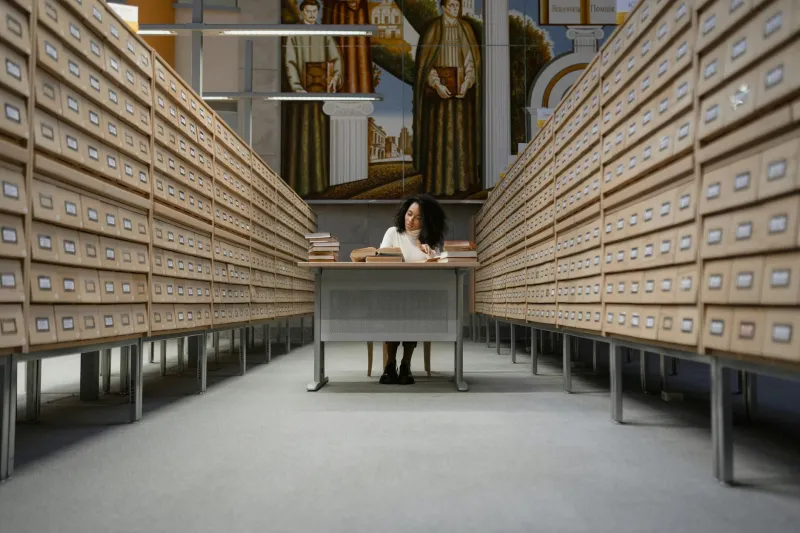
The card catalog system, which seems hopelessly antiquated now, was actually a marvel of information organization. Every book, magazine, and document was cross-referenced by author, title, and subject, creating a physical search engine that skilled librarians could navigate with stunning speed.
When Librarians Were Information Athletes
Reference librarians in the pre-internet era were intellectual athletes. They memorized the location of thousands of resources, understood the strengths and weaknesses of different reference materials, and could triangulate information from multiple sources to answer complex questions.
Mrs. Patterson knew that the 1973 World Almanac had the most accurate population figures, but the Encyclopedia Britannica had better historical context. She understood which periodical indexes to check for recent magazine articles and how to use inter-library loan systems to access materials from across the country.
 Photo: Encyclopedia Britannica, via i.pinimg.com
These librarians didn't just find information — they evaluated it. They could distinguish between reliable and unreliable sources, explain the bias in different publications, and guide patrons toward the most authoritative answers. They were human fact-checkers in an era when misinformation traveled slowly enough to be caught and corrected.
The Democratic Promise of Free Knowledge
Public libraries represented something uniquely American: the idea that access to information should be free and universal. A factory worker's child could access the same encyclopedias and reference materials as the banker's son. The library was the great equalizer, providing intellectual resources that most families couldn't afford to own.
This wasn't just about books. Libraries provided access to expensive periodicals, government documents, and specialized references that cost hundreds of dollars. The reference collection at a major library represented an investment that few individuals could match, making the library genuinely more powerful than private resources.
For immigrants, libraries were particularly crucial. They offered English-language learning materials, citizenship test preparation, and access to American culture and history. The library was often an immigrant family's first encounter with American democratic ideals — the radical notion that knowledge belonged to everyone.
The Research Ritual
Doing research in the pre-internet era was a physical, social activity. Students and adults would spend hours in libraries, surrounded by stacks of books and periodicals, taking notes by hand. The process was slow but thorough — you couldn't quickly jump from source to source, so you learned to read deeply and think carefully about each piece of information.
Librarians guided this process, teaching people how to research effectively. They showed students how to narrow broad topics, find authoritative sources, and organize information logically. These were life skills that extended far beyond academic assignments — they were training in how to think critically about information.
The social aspect was crucial. Libraries were places where knowledge was shared communally. Strangers would help each other find materials, librarians would introduce researchers working on similar topics, and the act of learning was embedded in a community context.
The Quiet Revolution
The transformation began gradually in the 1990s as computers appeared in libraries, initially as tools to enhance rather than replace traditional services. Early library databases were expensive and limited, requiring trained staff to operate effectively.
But the internet changed everything almost overnight. Suddenly, anyone with a computer could access more information in minutes than most libraries could provide in hours. The reference desk, once the busiest part of any library, became increasingly quiet.
By 2010, circulation statistics told the story. While book borrowing remained steady in many communities, reference questions dropped by 80% or more. The librarians who once fielded dozens of complex research questions daily now spent their time helping people print boarding passes and navigate job application websites.
What the Internet Couldn't Replace
Google can find information faster than any librarian ever could, but it can't replicate what made librarians truly valuable: the ability to understand what people actually needed, not just what they asked for.
Mrs. Patterson understood that the teenager asking about "careers in science" might really need guidance about college applications, or that the small business owner requesting tax information might benefit from entrepreneurship resources he didn't know existed. She could see connections between different types of information and guide people toward resources they never would have discovered on their own.
Librarians also provided quality control that the internet lacks. They could distinguish between reliable and questionable sources, explain the limitations of different materials, and help people understand the context behind information. In an era of information overload and deliberate misinformation, these skills have become more valuable, not less.
The Underused Palace
Today's public libraries are architectural paradoxes — beautiful buildings filled with resources that most Americans never use. They've adapted by offering computer classes, maker spaces, and community programming, but their core function as information centers has largely disappeared.
The irony is profound. At a time when access to reliable information has never been more important, we've abandoned the institutions that specialized in helping people find and evaluate information. We've traded the expertise of trained professionals for the convenience of search algorithms that can't distinguish between facts and opinions.
The Lost Art of Asking Better Questions
Perhaps the greatest loss is the relationship between librarian and patron that helped people learn how to ask better questions. Mrs. Patterson didn't just answer what you asked — she helped you understand what you should have asked.
This collaborative approach to information-seeking created better researchers and more thoughtful citizens. It taught people that good answers often required refining questions, that reliable information took time to find, and that knowledge was most valuable when it was carefully considered rather than quickly consumed.
The internet has made us all amateur librarians, but most of us lack the training to do the job well. We've gained unprecedented access to information while losing the skills to evaluate and use it effectively. In our rush to make knowledge instantly available, we forgot that wisdom comes not from finding answers quickly, but from learning to ask the right questions — something that Mrs. Patterson understood better than any search engine ever will.