You Used to Rip the Wrapping Paper Without a Clue. Now Christmas Morning Is a Delivery Confirmation.
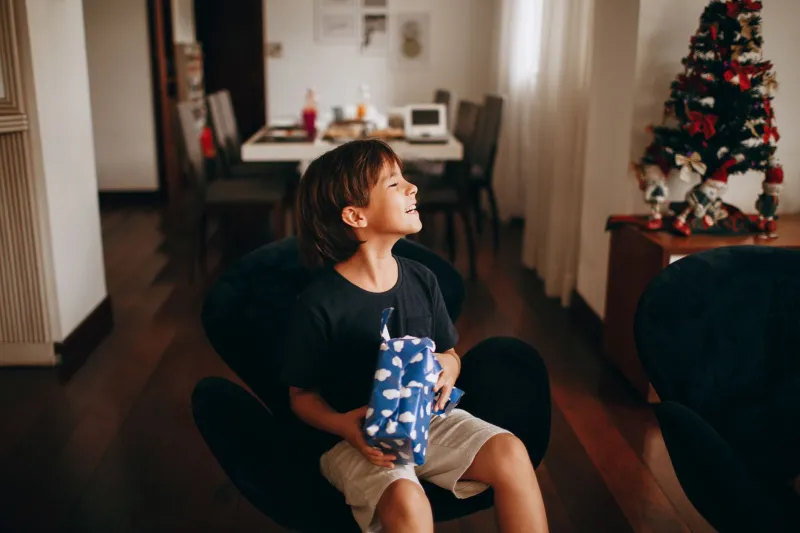
Picture Christmas morning in 1991. You're nine years old. You've been up since 5 a.m. staring at a pile of wrapped boxes that could contain almost anything. You've shaken them, weighed them in your arms, tried to read the shapes through the paper. You have theories. You have hopes. You have absolutely no certainty whatsoever.
When you finally tear into the first package, there is a genuine moment of discovery — a split second where the world reorganizes itself around what's actually in your hands. Sometimes it's exactly what you wanted. Sometimes it's a total surprise that turns out to be better than what you wanted. Sometimes it's a sweater from Grandma. But the not-knowing was real. The surprise was real.
Now picture Christmas morning in 2024. The 11-year-old in the living room already knows, within reasonable certainty, what's in most of those boxes. She put the items in a shared family wish list in October, complete with direct links and size specifications. She watched the packages arrive via real-time tracking notifications. She may have even seen her parents' credit card statement. The wrapping paper is almost a formality at this point — a ritual gesture toward a surprise that no longer exists.
Something genuinely valuable has disappeared from American holiday life. And most of us are so accustomed to the new version that we've forgotten what we gave up.
How Gift-Giving Used to Actually Work
For most of the 20th century, giving a gift required a specific kind of effort: you had to know the person. You had to pay attention to what they mentioned wanting, what they admired in a store window, what they'd been doing without. Gift-giving was an act of observation and interpretation — a way of demonstrating that you'd been watching and listening.
Parents did this instinctively. They noted what their kids lingered over in the Sears catalog. They listened to offhand comments made in September and remembered them in December. They consulted other parents, asked neighbors, and made educated guesses. Sometimes they got it spectacularly right. Sometimes they got it completely wrong. Both outcomes were meaningful.
The wrong gift, in particular, carried its own kind of emotional content. The chemistry set when you wanted a bike. The board game you already owned. The doll when you'd outgrown dolls. These misses weren't failures — they were evidence that someone had tried to know you and gotten it slightly wrong, which is, when you think about it, one of the most human things imaginable.
Grandparents operated in a different register entirely. They gave gifts filtered through their own era's logic — practical things, handmade things, things that reflected values rather than wants. A grandmother who knitted you a cardigan wasn't missing the point. She was making a different point altogether.
The Wish List That Killed the Surprise
The transformation happened gradually, then all at once. It started innocently enough — families began sharing rough gift ideas to avoid duplicate presents or wasted money. That made sense. Then came Amazon wish lists in the late 1990s, which made sharing specific items easy and precise. Then came the smartphone era, where sharing a direct product link with a photo, price, and star rating became the default communication around gift-giving.
By the 2010s, many American families had essentially converted Christmas into a fulfillment operation. Kids submitted itemized lists. Parents purchased exact items from those lists. The only mystery left was the wrapping — and even that was sometimes bypassed with gift cards, which are essentially just money with an extra step.
Package tracking completed the transformation. When a child can watch a UPS truck move across a map on their phone and know that "your item is two stops away," the arrival of a gift is no longer an event — it's a scheduled appointment. The emotional arc of anticipation, uncertainty, and discovery has been compressed into a logistics notification.
What Surprise Was Actually Doing
Surprise isn't just a pleasant sensation. Psychologists who study emotion and reward have found that unexpected positive events produce significantly stronger emotional responses than anticipated ones. The brain's dopamine system responds more intensely to unpredicted rewards than to expected ones — which is why the gift you didn't see coming tends to feel more meaningful than the one you picked out yourself.
There's also the question of what gift-giving communicates. When someone gives you something they chose specifically for you — based on what they know about you, what they've observed, what they thought you'd love — it carries a relational message that a fulfilled wish list simply cannot replicate. The message is: I was paying attention to you. I thought about you. I tried.
When you give someone exactly what they asked for, the message is different. It's efficient and considerate, certainly. But it's closer to: I wanted you to have what you wanted. Which is kind, but it's a different kind.
Children who grow up in the wish-list era are being raised on the second kind of gift — the optimized, preference-matched, efficiently delivered kind. It's not nothing. But it's also not the experience of being surprised by someone who knew you well enough to guess.
The Broader Pattern
The disappearance of gift-giving mystery isn't happening in isolation. It's part of a larger cultural shift toward predictability and immediate gratification that touches almost every corner of modern American life. We stream movies we've already read reviews of. We go to restaurants after checking photos of every dish online. We date people after extensive social media research. We've engineered surprise out of most experiences because uncertainty feels inefficient.
But the cost of eliminating uncertainty is that we also eliminate the emotional intensity that comes with genuine discovery. Life becomes more comfortable and less vivid. The moments that stick with you — the ones you describe to people decades later — are almost always the ones you didn't see coming.
That Christmas morning in 1991, when the wrapping came off something completely unexpected and your whole face changed — that's still in your memory. The Christmas where you got exactly what you put on your list is harder to place.
The Paper Was Never Really the Point
Nobody is arguing that we should go back to guessing wrong and giving bad gifts. Wish lists prevent waste and disappointment, and there's real value in that. But somewhere between "I hope they like this" and "here is the exact item you specified at the price point you indicated," we lost something that mattered.
We lost the version of Christmas morning where the world could still surprise you. Where the people who loved you could demonstrate that love through the specific, imperfect, deeply human act of guessing. Where ripping paper open was a genuine act of discovery rather than a confirmation of what you already knew was inside.
The gift was never really the object. It was the moment of not knowing — and then finding out.