He Remembered Your Name, Your Kids, and Exactly How You Liked Your Ribeye
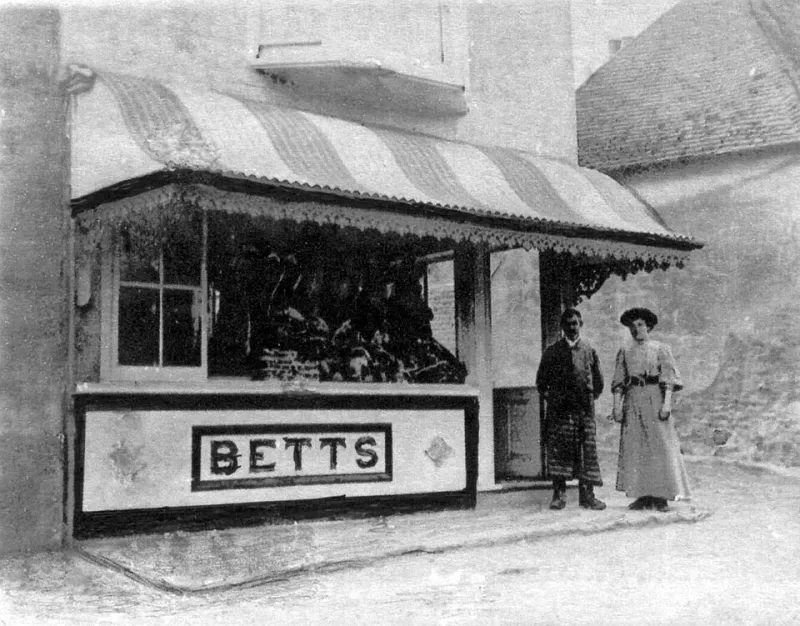
Photo: Unknown authorUnknown author, Public domain, via Wikimedia Commons
Somewhere between the postwar boom and the age of two-day shipping, a particular kind of American institution quietly vanished. It smelled like sawdust and cold air. It had a glass case running the length of the room. And behind that case stood someone who had spent years — sometimes decades — learning a single craft well enough to be genuinely useful to you.
The neighborhood butcher shop is mostly gone now. What replaced it is more convenient, arguably more hygienic, and infinitely less interesting.
A Trade That Took Years to Learn
Becoming a skilled butcher in mid-20th century America wasn't something you did in a weekend training session. It was an apprenticeship — a years-long education in anatomy, aging, cutting technique, and the subtle art of knowing which cut suited which purpose. A good butcher understood the whole animal, not just the familiar retail cuts. He knew which muscles worked hard and needed slow cooking, which ones barely moved and could be eaten rare, and how to break down a carcass in a way that maximized value for both his business and his customers.
That expertise translated directly into the customer experience. When you walked into a neighborhood butcher shop in 1955 or 1965, you weren't browsing a refrigerated case of pre-wrapped mystery packages. You were having a conversation. You'd tell him what you were making for Sunday dinner, how many people were coming, and roughly what you wanted to spend — and he'd make a recommendation, trim it the way you liked, and sometimes throw in advice about how to cook it that you hadn't asked for but genuinely needed.
For regular customers, it went further. The butcher remembered that you preferred your steaks cut thick. He knew your husband didn't like too much fat. He'd set aside a particular cut when he got something special in, because he knew you'd want it.
The Supermarket Takeover
The decline of the independent butcher shop tracked closely with the rise of the supermarket — a process that accelerated dramatically through the 1950s and 1960s. Supermarkets offered something the corner shop couldn't easily compete with: everything under one roof, at lower prices, during extended hours.
The meat case in a supermarket was a fundamentally different proposition. Cuts arrived pre-portioned and plastic-wrapped from centralized processing facilities. The person behind the counter — if there was one at all — was a department employee rather than a craftsman. The selection was standardized to match what moved fastest: your ribeyes, your T-bones, your ground beef, your chicken breasts. Anything unusual required a special order, if it was available at all.
By the 1980s, independent butcher shops had become something of a rarity outside of ethnic neighborhoods, high-end urban enclaves, and rural communities where the tradition held on longer. The generation of men who had learned the trade from their fathers began to retire, and fewer young people were stepping in to replace them.
When the Algorithm Took the Counter
The latest chapter in this story is the online meat delivery service — a category that exploded during the pandemic and has continued growing since. Companies like ButcherBox, Crowd Cow, and Snake River Farms now ship vacuum-sealed cuts directly to your door, often with detailed descriptions of the farm, the breed, and the aging process.
In some ways, this is a genuine improvement over the average supermarket experience. The sourcing is often more transparent, the quality more consistent, and the range of cuts broader than what you'd find in most chain grocery stores.
But the algorithm that curates your box doesn't know you. It knows your order history, your stated preferences, and the items other customers with similar profiles have purchased. It can tell you the USDA grade of your strip steak. It cannot tell you that the chuck roast you're planning to braise will actually be better if you let it go an extra hour, or that the pork shoulder you're eyeing would be absolutely transformed by a 24-hour dry rub. That kind of knowledge — relational, contextual, earned through years of watching customers cook and return — doesn't fit in a fulfillment warehouse.
The Broader Loss
The butcher shop's disappearance is really a story about what happens when specialized human expertise gets replaced by systems optimized for scale. The supermarket can serve ten times as many customers as the corner shop. The fulfillment warehouse can serve ten thousand times as many. But something real is traded away in that exchange.
There's a word for what the neighborhood butcher provided that gets used a lot in business writing but rarely in its original sense: expertise. Not certification, not training modules, not a product knowledge quiz — but the accumulated, applied understanding of a craft that only comes from doing it, day after day, with real customers who gave you real feedback.
The hardware store owner who knew exactly which drill bit you needed. The pharmacist who remembered your allergies without looking them up. The tailor who could tell from a glance what was wrong with your jacket. These were the human infrastructure of everyday American commerce, and they've been systematically replaced by self-service kiosks, dropdown menus, and customer service chatbots.
None of those replacements are bad, exactly. They're faster, cheaper, and available at 2 a.m. But they don't remember your name. They don't notice that you seem stressed and ask if everything's okay. They don't set aside something special because they thought of you.
The Shops That Survived
A small but genuine revival of the craft butcher has been underway for about fifteen years, concentrated in cities with strong food cultures — New York, Chicago, Portland, Nashville, Austin. These shops tend to be expensive, self-consciously artisanal, and staffed by young people who chose the trade deliberately rather than inheriting it. They are, in their way, wonderful.
 Photo: New York, via cdn.pixabay.com
But they serve a different customer than the old neighborhood shop did. They're a premium option rather than a community fixture. The butcher your grandmother talked to every Thursday wasn't a luxury — he was just part of how the neighborhood worked.
That version of things is mostly gone. And the ribeye, however perfectly it arrives on your doorstep, doesn't quite taste the same without the conversation that used to come with it.